

Political earthquake in Europe: Students in the streets, fires and tear gas - From France to Albania, rage reaches governments
Schools under occupation, thousands of youth in the streets, tear gas, injuries, torched buildings, and governments facing mounting pressure. From Emmanuel Macron's France to Edi Rama's Albania, the student and pupil mobilizations of October 2026 have evolved into much more than a protest over education. Behind the clashes emerges a deeper crisis of trust in the political system, at a time when upcoming electoral contests acquire special significance.


From school classrooms to the streets — How the explosion started
The image forming in Europe over recent weeks causes intense concern. Thousands of pupils and students are abandoning classrooms, organizing mobilizations, and clashing with government policies, denouncing that the educational system no longer offers them the opportunities they were promised. In France, the protest wave began from daily school life problems: teacher shortages, overcrowded classes, facilities needing repairs, and uncertainty regarding access to higher education. In Albania, discontent over study costs and limited career prospects combined with broader allegations of corruption and challenges to the government. Despite differing conditions, there is a common denominator: young people who feel that political decisions determine their future without seriously considering their needs.
France: Over 1,000 schools in mobilizations — The crisis escapes educational bounds
France sits at the epicenter of the new student unrest. Mobilizations began in late September, starting from the Saint-Exupéry high school in the Créteil area near Paris. Within days they spread to different regions of the country. On October 1, a decisive turning point occurred: according to Le Monde, more than 1,000 schools, nearly a quarter of the total, participated in the mobilizations. Students demanded more educators, better infrastructure, and substantive changes in the school environment. However, as protests expanded, their character changed as well. In several areas, school blockages were accompanied by clashes with police forces. Trash bins were set on fire, objects were hurled, and police used riot control means. Educators and school principals expressed concern that the situation was beginning to spin out of control, while acknowledging that many student demands were justified.
Tear gas, arrests, and injuries — Police response provokes fresh rage
Images from the French demonstrations opened a second, exceptionally sensitive front: the treatment of underage protesters. According to an Associated Press report on October 16, thousands of demonstrators, mostly under 18 years of age, have been arrested during the mobilization wave. Severe teenager injuries and allegations of excessive police force have also been recorded. On the other side, French police report over 900 injured officers and 150 school staff members, maintaining that violent groups exploit mobilizations for attacks and destruction. The confrontation no longer limits itself to whether students have a right to protest. It also concerns the proportionality of police intervention, the protection of minors, and the authorities' responsibility to prevent violence. For Emmanuel Macron, the crisis is evolving into yet another difficult test during the final months of his presidency. France possesses a long tradition of social mobilizations, but the participation of such a large number of students imparts special political weight to current unrest.
The 2027 budget and accumulated discontent
The explosion of student rage cannot be decoupled from broader fiscal pressures in France. Student mobilizations coincided with public sector strikes and intense reactions against government budget proposals. On October 13, as parliamentary debate for the 2027 budget commenced, students and unions demonstrated again. Although the government proposal includes a €1.2 billion increase for the Ministry of Education, educational organizations consider that measures do not adequately address accumulated problems. Characteristically, out of 3,000 substitute teachers announced for priority schools, only 35% of the target had been achieved by October 13, according to Education Minister Édouard Geffray. This explains why government announcements have so far failed to restore trust. Students do not solely demand larger funds; they demand to see immediate changes in their daily lives.
Albania: From the "flamingo revolution" to the fires of Tirana
If in France the crisis started from school classrooms, in Albania the explosion of youth discontent possesses even deeper political and economic roots. Violent mobilizations in October did not appear suddenly. 


Three days of violent clashes — Fires in public buildings and banks
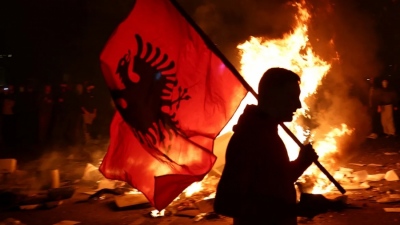
From October 13 to 15 (continuing into 10/16), Tirana transformed into the epicenter of severe clashes. Thousands of protesters, among them high school and university students, held marches demanding educational reforms and, in many cases, the resignation of Edi Rama. Mobilizations evolved into violent conflicts when groups of protesters attacked police cordons and government buildings. Fires were recorded in governmental facilities and bank branches, destruction of businesses, hurling of stones and fireworks, as well as police interventions with tear gas and water cannons. The Associated Press reported that 71 police officers were injured during incidents, alongside protester injuries and arrests. The Albanian government condemned destruction and accused political opponents of inciting violence. Conversely, mobilization organizers maintain that protests result from months of indifference toward their demands. The European Union delegation in Albania expressed concern over escalation and requested a proportionate response from authorities.
Why rage in Albania targets the entire political system
The Albanian case presents a particularly interesting difference from the French one. In France, the core of protests remains closely tied to public schooling, despite gradual politicization. In Albania, educational discontent integrated into an already shaped anti-government movement. Students denounce high study costs, inadequate financial support, and difficulties finding employment after graduation. Behind these demands lies a broader anxiety: that even acquiring a university degree does not ensure a decent professional and economic prospect. Concurrently, protest does not restrict itself exclusively to the government. Certain participants express distrust toward the traditional opposition as well, considering that previous decades' power alternations failed to address the country's structural problems. This explains why the movement struggles to fit into a simple government-opposition confrontation scheme.
Belgium and Italy: Protests cross borders
The picture is not confined to France and Albania. In October, student and pupil mobilizations were also recorded in Belgium and Italy. In Belgium, incidents in Liège were accompanied by arrests and temporary school closures. In Italy, students participated in demonstrations across various cities, though mobilization scale was smaller than France's and demands connected more closely to specific domestic conditions. It is therefore not substantiated that all of Europe faces a single unified uprising. However, parallel outbursts of youth discontent present common characteristics: anxiety about the future, distrust toward institutions, and a sense that political leaderships fail to respond to the new generation's needs.
In Greece
University students gathered outside the Ministry of Finance in Athens on Tuesday to protest rent hikes and the lack of affordable student housing. Scenes set at Syntagma Square near parliament during a protest in Athens.
The major political dimension: The 2027 French elections
The temporal juncture of demonstrations is exceptionally important. France approaches the 2027 presidential elections, in which Emmanuel Macron cannot claim a third consecutive term. Thus, mobilizations evolve into a core issue of pre-electoral confrontation. Jean-Luc Mélenchon, head of La France Insoumise, has sided with student demands, denouncing police handling of demonstrations. Within his political intervention framework, he has proposed lowering the voting age limit to 16 and changes to university access systems. From a different political starting point, Marine Le Pen has advocated strengthening police powers against violent protesters, while Édouard Philippe has condemned attacks and destruction. In this manner, the same social event transforms into a field of confrontation among differing political perceptions on public education, security, and the role of the state.
Can students influence the ballot box?
Interestingly, many current students lack voting rights as yet. Nevertheless, mobilizations can influence political debate in three ways. First, they bring the state of education to the center of the pre-electoral agenda, forcing candidates to present concrete proposals. Second, they can mobilize families, educators, and older youth who already hold voting rights. Third, they highlight differing perceptions on police management of social mobilizations. Electoral impact, however, is not given. In the 2022 presidential elections, according to data cited by Le Monde, Jean-Luc Mélenchon gathered 36% among voters aged 18–24, but turnout for this age group reached only 52%. This example shows why massive youth presence in the streets does not automatically translate into corresponding electoral turnout or support for a specific candidate.
Albania: Edi Rama facing demands for early elections
In Albania, the electoral dimension differs. Edi Rama secured a fourth consecutive election victory in 2025, while the next scheduled parliamentary elections are projected for 2029. Consequently, no immediate scheduled national electoral contest comparable to France's exists. However, the opposition Democratic Party has expressed support for demonstrations and demands forming a caretaker government aiming to hold early elections. Edi Rama rejects the resignation demand and insists governments change through the democratic electoral process. Here lies the core political confrontation: protesters demanding government change seek immediate developments, whereas the government invokes the popular mandate received just the previous year. Mobilizations can increase political pressure, but do not automatically entail early elections. Such an outcome would require specific political and institutional developments.
The deeper crisis: A generation no longer trusting promises
Behind the images of incidents lies a social issue unexplained solely through partisan confrontation. In France, students describe schools with staff shortages, overly demanding curricula, and infrastructure problems. In Albania, youth speak of expensive studies, career placement difficulties, and a political environment where they feel unrepresented. The two societies differ significantly regarding economic status, educational systems, and institutions. Yet the sense of uncertainty regarding the future appears in both cases. Education traditionally links with the promise of social progress. When youth consider this promise unfulfilled, discontent can transform into political challenge. This does not mean all demonstrators hold identical views or seek political system overthrow; rather, specific educational problems can serve as a springboard for broader social mobilization.
The risk of escalation — When protest meets violence
Developments in France and Albania also highlight a significant risk. As tension mounts, initial demands increasingly risk being overshadowed by clash imagery. In France, the ACLED organization recorded over 800 student demonstrations solely between September 28 and October 2. Concurrently, it reports severe destruction and police violence incidents, including heavy student injuries. In Albania, attacks on public buildings and police led to even more intense confrontations regarding protest limits and state reaction. Condemnation of violence against individuals and infrastructure does not negate the need to examine social causes behind mobilizations. Correspondingly, justified demands do not render attacks acceptable. The challenge for governments is safeguarding public safety while protecting the right to peaceful protest and addressing problems provoking it.
www.bankingnews.gr





Σχόλια αναγνωστών